Home > News > Disc Spring Selection Guide: Specifications and Application Matching Tips for Industrial Disc Springs
As an essential elastic component in industrial equipment, disc springs are widely used in engineering machinery, metallurgy, chemical processing, aerospace, and many other industries. Their advantages include compact structure, high load capacity, and controllable deformation, making them ideal for applications requiring reliable force and space efficiency.
However, during procurement and selection, many companies face challenges due to insufficient understanding of specification parameters and working condition compatibility. Improper selection can lead to short service life, poor adaptability, or even equipment malfunction.Based on many years of industrial spring manufacturing experience from HEGONG SPRING ®, this guide summarizes practical disc spring selection principles, explains key specification parameters, and shares application matching techniques for different working conditions to help companies avoid common selection mistakes.
The primary prerequisite for selecting disc springs is to clearly understand the core specification parameters, which form the foundation for proper equipment compatibility.
Industrial disc spring specifications mainly focus on six key parameters:
Material
Thickness
Outer diameter
Inner diameter
Load capacity
Deflection (deformation)
In terms of material, 65Mn spring steel is commonly used for standard industrial applications because of its excellent elasticity and toughness. For environments involving high temperatures or corrosive conditions, stainless steel materials are recommended. These materials can operate in environments above 200°C, reducing the risk of oxidation or performance degradation.
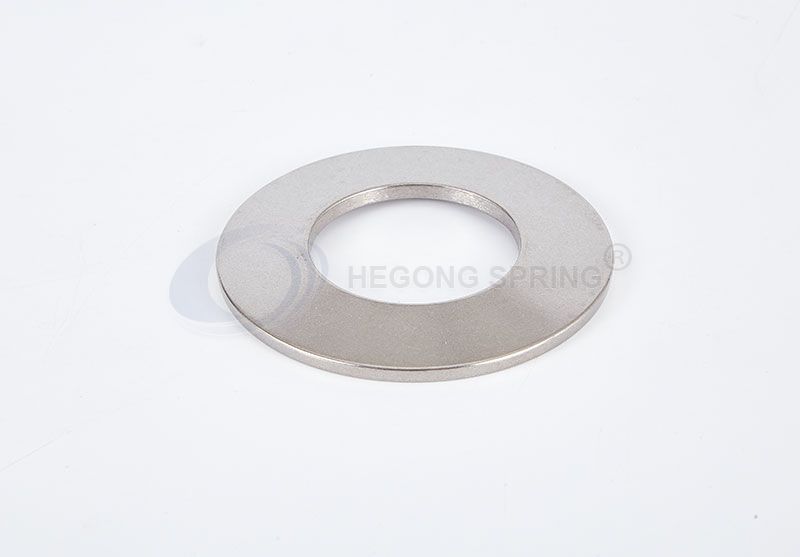
Thickness and diameter dimensions directly determine the load-bearing capability of the spring. Typical industrial disc spring specifications include:
Thickness: 0.5–10 mm
Outer diameter: 10–200 mm
Inner diameter: 5–180 mm
When selecting a spring, companies should match these dimensions carefully according to installation space and load requirements, avoiding springs that are too large to install or too small to handle the required load.
Proper matching of load capacity and deflection is the most critical part of disc spring selection and also where many companies make mistakes.
Disc spring load is generally divided into:
Working load
Maximum load
The working load should match the actual operating force of the equipment, while the maximum load should be at least 1.2 times greater than the maximum force applied by the equipment, preventing overload damage.
Deflection should correspond to the required operating stroke of the equipment. For typical industrial applications, disc spring deflection generally ranges from 0.1 mm to 5 mm.
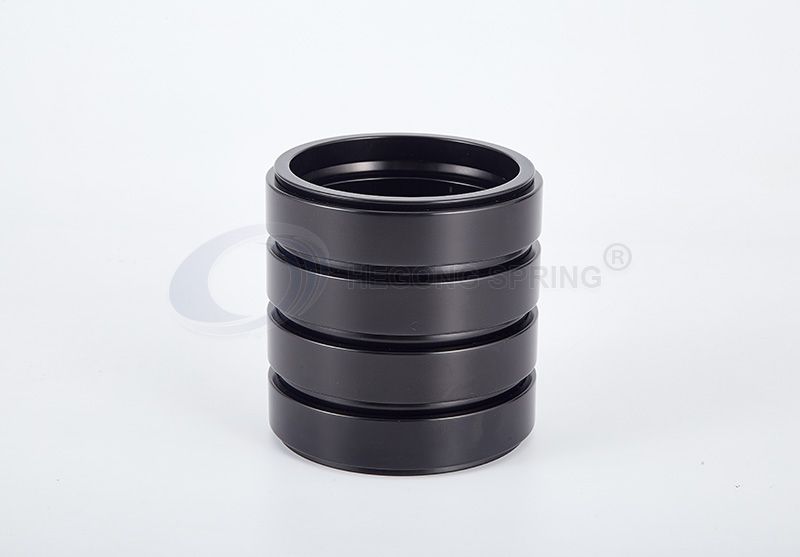
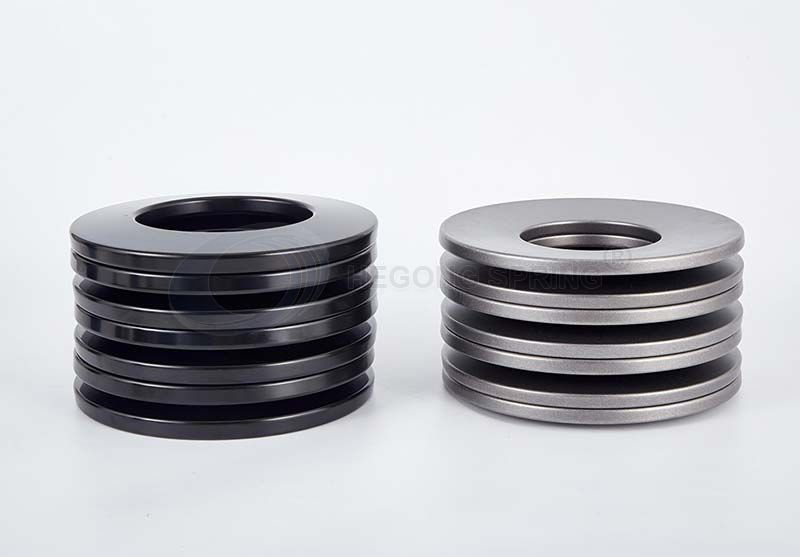
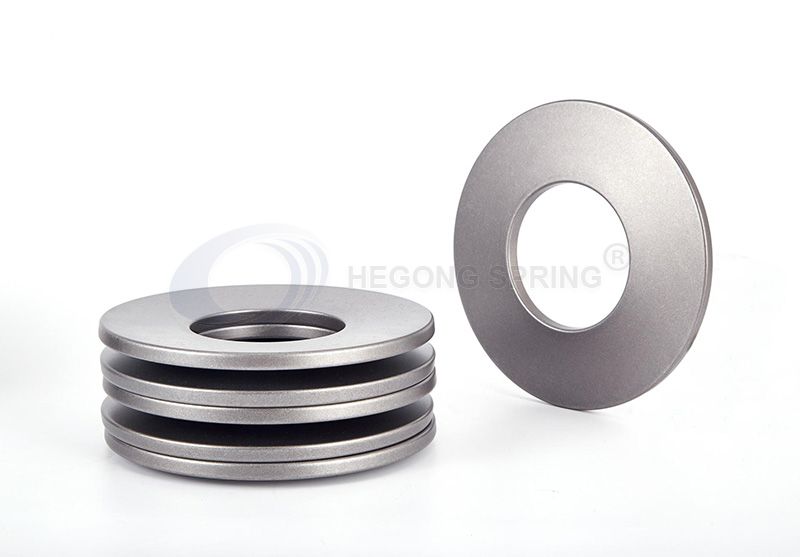
If the equipment requires a larger working stroke, multiple disc springs can be stacked together. The number of stacked springs can be adjusted according to the required displacement. However, it is important to note that the total load will also increase when springs are stacked, so the overall load compatibility must be recalculated.
Different industries and operating environments require different disc spring configurations. Accurate matching can significantly extend service life and ensure stable equipment operation.
In engineering machinery such as excavators and cranes, disc springs are often used in hydraulic systems that experience frequent shock loads. These applications require high-strength, fatigue-resistant springs, with 65Mn spring steel being a common choice. Springs with larger outer diameters and medium thickness are often preferred to withstand high-frequency impact loads.
In metallurgical applications, equipment frequently operates under high-temperature conditions. High-temperature disc springs made from heat-resistant stainless steel are recommended. In addition, optimizing spring structure helps reduce deformation at elevated temperatures, preventing sealing problems or performance loss.
Chemical processing environments often contain acidic or alkaline corrosive media. In these conditions, disc springs made from corrosion-resistant stainless steel are necessary. Surface anti-corrosion treatments can further enhance durability and extend service life.
For precision instruments and equipment, small-size disc springs with high dimensional accuracy are required. Dimensional tolerances are typically controlled within ±0.01 mm to ensure stable elastic performance and maintain the accuracy of sensitive equipment.
In addition, installation methods must also be considered during selection. Disc springs are commonly installed using:
Series stacking
Parallel stacking
Combination stacking
The appropriate configuration should be chosen based on installation space and load direction.
When selecting disc springs, companies should avoid two common mistakes:
1. Blindly pursuing higher load capacity
Ignoring installation space and deflection requirements may lead to springs that cannot be properly installed or function effectively.
2. Focusing only on dimensions while ignoring material compatibility
Choosing the wrong material for the operating environment can lead to premature spring failure.
Before selecting disc springs, companies should clearly determine:
Equipment load conditions
Installation space
Operating environment
If necessary, consulting a professional manufacturer for custom design solutions can ensure accurate product selection.
With years of expertise in disc spring manufacturing, HEGONG SPRING ® provides full-range and customized disc spring solutions tailored to various industrial applications. Combined with professional selection guidance, HEGONG SPRING ® helps customers achieve efficient product selection, reliable equipment performance, and reduced long-term operating costs.